Leaking appliance, answered 24/7
Appliance leak cleanup in Los Angeles, from heaters to washers
Appliance leaks hide. The water runs under the cabinet or behind the machine for days before anyone sees it, so the damage is usually bigger than the puddle.
- Answered 24/7
- Water heaters and washers
- Dishwashers and fridge lines
Updated September 2026
24/7 emergency line
(323) 709-0141- 1Shut the appliance valveOr the main if you cannot find it.
- 2Pull it out if safeUnplug first, then look behind.
- 3We extract and openCabinets, kick plates, walls.
Quick answer
For an appliance leak in Los Angeles, shut the valve feeding the appliance, unplug it, and call. Water heaters, washers, dishwashers and ice maker lines leak slowly under cabinets and behind walls, so we extract what is visible and then read and open the hidden areas, like cabinet bases and wall cavities, before drying.
What you might notice
Signs an appliance has been leaking
Cupping floor
Boards rising near the fridge or dishwasher.
Swollen cabinet base
Particle board flaring at the bottom.
Rust at the tank base
Water heater pan or floor staining.
Musty sink cabinet
Smell when you open the door.
Water bill jump
Higher use with no obvious leak.
Loose tiles
Near the washer or dishwasher.
Ceiling stain below
Under an upstairs laundry.
How the job runs
How we clean up an appliance leak
WetDry and signed off
- 1
Water off at the source
Appliance valve or main shutoff.
- 2
Pull the appliance
Unplugged and moved to see behind.
- 3
Extract visible water
Floor, cabinet interiors and base.
- 4
Read hidden areas
Cabinet bases, subfloor and wall cavity.
- 5
Remove what swelled
Particle board, toe kicks and baseboard.
- 6
Dry in place
Air movers, dehumidifier, cavity drying.
- 7
Confirm and hand over
Dry readings, photos and notes.
The job
Why appliance leaks do more damage than they look
A split washer hose can put out gallons a minute; a dishwasher drain or an ice maker line may drip for weeks. Either way the water gets under cabinets, into particle board and into the wall behind the machine.
Most appliance water is clean or gray. Caught early it dries. Found late, it usually means cabinet bases and flooring come out. An air conditioner is its own case; see when the AC drain backs up.
Variations of this job
Water heater leak
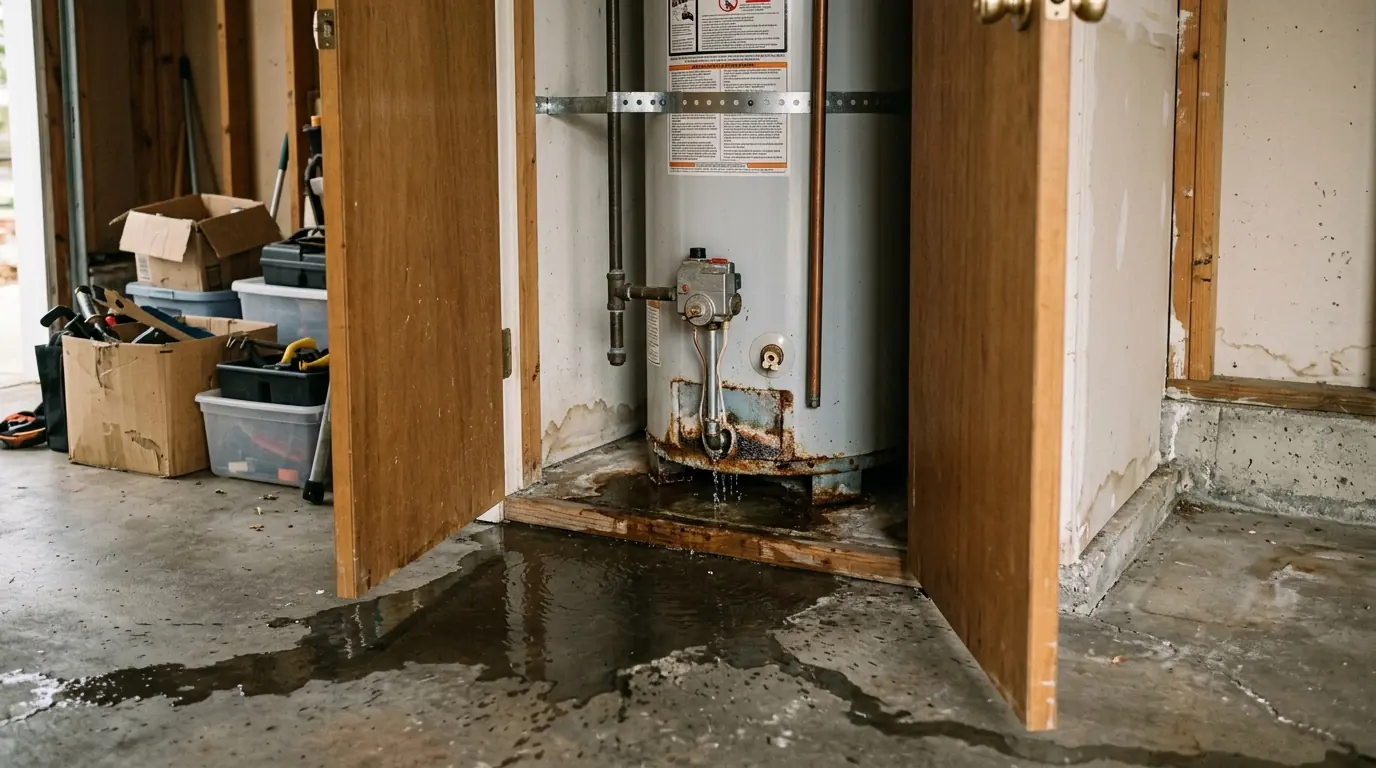
A water heater leak usually starts at the bottom of the tank once the lining rusts through, or at a relief valve or fitting on top. Tanks from Rheem, A. O. Smith, Bradford White and every other maker fail the same way near the end of their life. Garage heaters leak onto concrete, but closet heaters inside the house soak the floor and wall behind them. We extract, pull the baseboard, dry the cavity and leave the heater replacement to your plumber.
Washing machine overflow
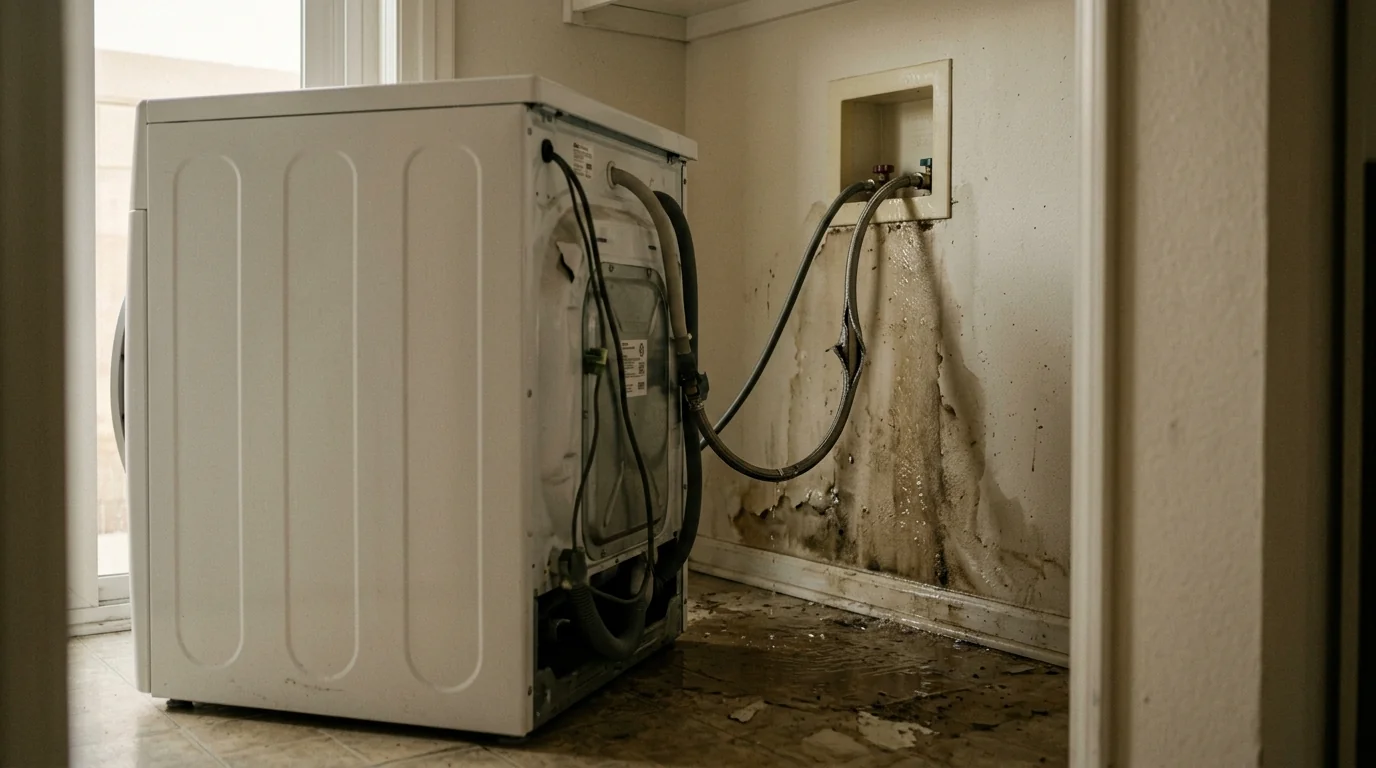
A washing machine overflow is either a burst supply hose, which floods fast, or a drain problem that overflows each cycle. Upstairs laundry rooms send the water into the ceiling below. Front-loaders from Whirlpool and others can also leak slowly at the door seal. We extract the laundry room and anything below it, pull the machine to check the wall and floor behind, and dry. Braided steel supply hoses are worth fitting afterward, and we can point out the valves you should know about.
Dishwasher and refrigerator line leaks
Dishwasher and refrigerator line leaks are the slow ones. A loose dishwasher drain connection or a cracked plastic ice maker line drips under the counter or behind the fridge until the flooring cups or the cabinet base swells. We pull the kick plate and the appliance, read the cabinet base and subfloor, and remove swollen particle board, because it does not shrink back. Hardwood next to the fridge is often the first thing that shows it, as cupped boards along the front edge.
Los Angeles conditions
Hard water shortens appliance life here
Los Angeles tap water runs moderately hard to hard, roughly 7 to 16 grains per gallon depending on the neighborhood's source blend. Hard water leaves scale inside water heater tanks and on valves, fill lines and washer inlet screens, which is part of why the tank failures and slow fitting leaks we see often come a few years earlier than people expect.
Do it yourself or call
What you can do right away
The first ten minutes matter most, and most of it you can do yourself.
| What you can do | What we handle | |
|---|---|---|
| Water heater leaking | Close the cold inlet, power off | Extract and dry; plumber replaces |
| Washer hose burst | Close both valves behind it | Extract, check the wall and below |
| Dishwasher leak | Close the valve under the sink | Pull it, read the cabinet base |
| Fridge line drip | Close the saddle or line valve | Read and dry the floor under it |
Cost factors
What appliance leak cleanup costs
2026 guides put most water damage restoration between $1,384 and $6,387, with gray water mitigation at $4 to $7 per square foot. A heater leak on garage concrete sits low; a slow leak under kitchen cabinets sits higher.
How long it leaked
Hours versus weeks changes everything.
Water type
Supply water versus washer or drain water.
Cabinets
Swollen bases and toe kicks replaced.
Flooring
Hardwood and laminate near the leak.
Floor below
Upstairs laundry adds a ceiling.
Drying days
Equipment and daily readings.
The leaks we dry out come from every brand
FAQ
Appliance leak questions
No. We handle the water damage; your plumber replaces the heater. We document the failure for the claim.
Clean from the supply hose, gray from the drain. Gray water gets disinfected before drying.
Usually a slow ice maker line leak. The boards soak from below before any puddle shows.
Particle board that swelled does not shrink back. Solid wood often dries fine.
Sudden failures often are; long slow leaks often are not. We document when it started.
Braided steel hoses, a leak pan under the heater and a leak sensor behind appliances help.
Related work
What else the same leak can lead to
Emergency Water Damage Restoration
24 hour water damage cleanup
How we handle emergency Water Damage RestorationBurst Pipe Cleanup
Supply line failure
How we handle burst Pipe CleanupCeiling and Roof Leak Water Damage
Sagging ceiling
How we handle ceiling and Roof Leak Water DamageSlab Leak Water Damage
Hot spot on floor
How we handle slab Leak Water DamageToilet Overflow Cleanup
Clean water overflow
How we handle toilet Overflow CleanupAppliance leaking right now?
Close its valve, unplug it and call. We will tell you what to check while we head over.
24/7 emergency line
(323) 709-0141