Burst line, answered 24/7
Burst pipe water cleanup in Los Angeles, any hour
A burst supply line puts out clean water under full pressure, so it spreads fast. The upside is that clean water caught quickly is the most recoverable loss there is.
- Answered 24/7
- Supply lines and fittings
- Copper and galvanized
Updated September 2026
24/7 emergency line
(323) 709-0141- 1Close the main valveThen open a low faucet.
- 2Power off if wetOnly from a dry panel.
- 3We extract and openWalls, ceilings, cabinets.
Quick answer
For a burst pipe in Los Angeles, close the main water valve, open a low faucet to drain the line, and turn off power to wet rooms if the panel is dry. Supply water is clean, so most walls and floors can be dried in place if extraction starts the same day; we open only what soaked through.
What you might notice
Signs a pipe is leaking inside a wall
Bubbling paint
A blister that grows over days.
Hissing sound
In a wall with the taps off.
Low pressure
One fixture weaker than before.
Rusty water
From old galvanized lines.
Damp baseboard
Along a bathroom or kitchen wall.
Meter moving
With every fixture off.
Stain below a bath
On the ceiling downstairs.
How the job runs
From a burst line to a dry house
WetDry and signed off
- 1
Main off, line drained
Stops pressure feeding the leak.
- 2
Photograph the damage
Before anything is moved.
- 3
Extract standing water
Floors, carpet and pad.
- 4
Map the wet area
Meters and thermal imaging.
- 5
Open for the repair
Small, clean openings at the leak.
- 6
Dry in place
Cavity drying, air movers, dehumidifier.
- 7
Close up
Patch, texture and paint once dry.
The job
Why burst pipe damage is usually recoverable
A supply line carries clean water, so unlike sewage or flood water, the materials it soaks can usually be dried rather than thrown out.
The catch is volume and time. A pipe under pressure can wet several rooms in minutes, and after a day or two clean water starts to degrade.
Variations of this job
Supply line failure
Supply line failure is the most common burst we see: the flexible hose feeding a toilet, faucet, washer or water heater splits or pops off its fitting. A braided line feeding a Rinnai or Navien tankless heater, or the supply under an American Standard toilet, can fail after years of vibration and hard water. These leaks run fast and in the open, so they are usually found quickly. We extract, pull baseboard and cabinet toe kicks, and dry the wall bottoms and subfloor.
Pinhole copper leak
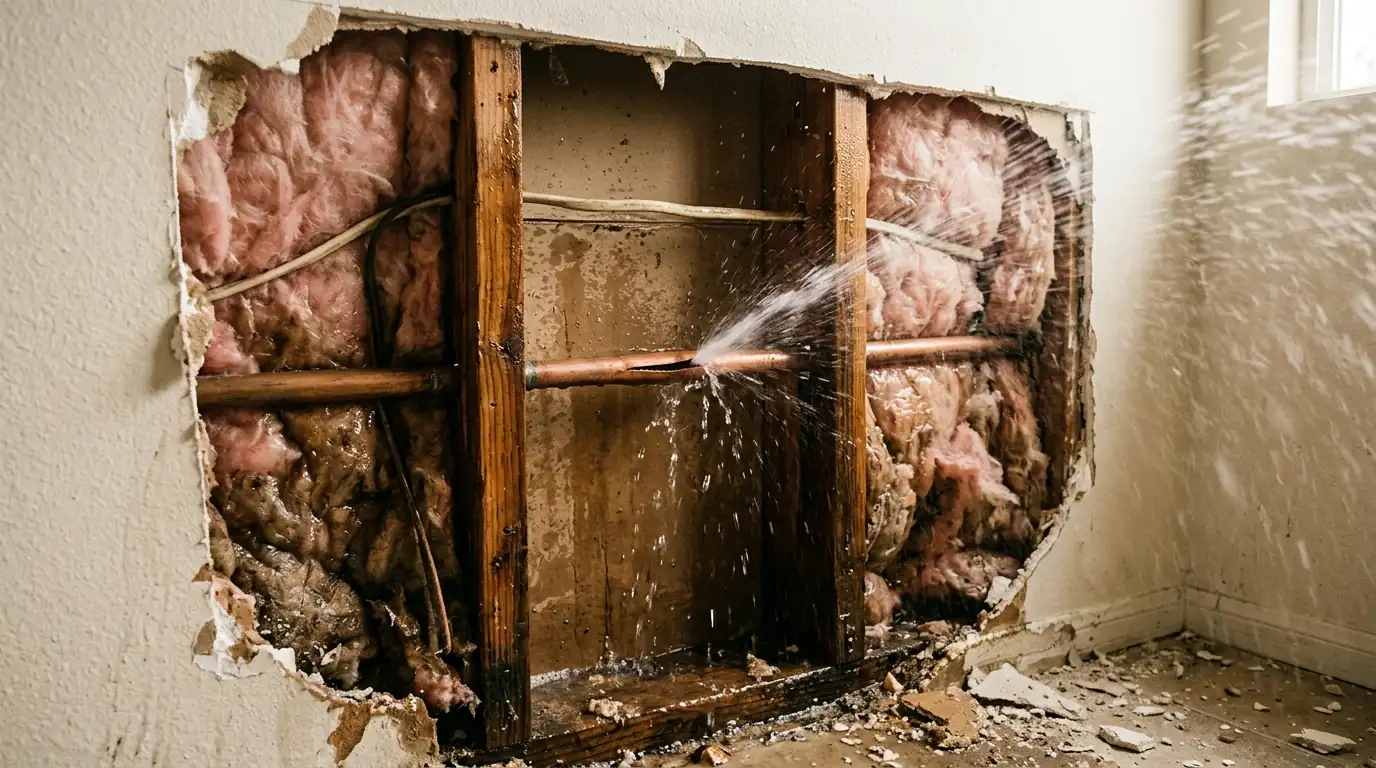
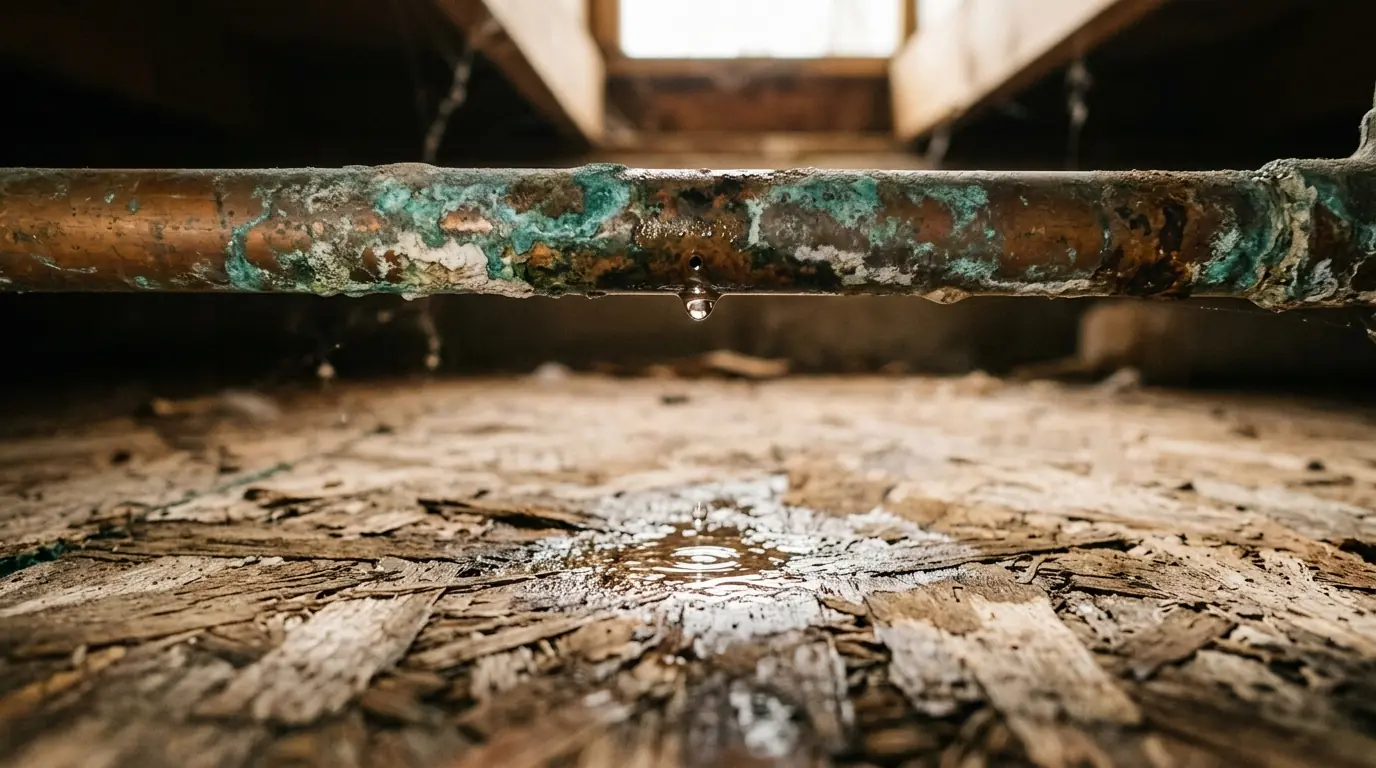
A pinhole copper leak is a tiny hole worn through the pipe wall, usually inside a wall or ceiling. It sprays a fine jet that soaks insulation and drywall for days before a stain or bubble shows. When it finally lets go, the wall is wet top to bottom. We find the wet area with a thermal camera and meters, open the drywall around the leak so the plumber can repair it, and dry the cavity with cavity drying rather than opening the whole wall.
Galvanized pipe failure
Galvanized pipe failure happens in older homes that still have steel supply pipes, which rust from the inside until a joint or a thinned section gives way. The water is often rust-colored at first. Because galvanized lines tend to fail more than once, the plumber may recommend replacing sections or repiping. We handle the water damage from each failure, and when walls are open for a repipe, we dry and rebuild them in the same scope, so the house only goes through one round of open walls.
Los Angeles conditions
Old plumbing across most of the city
Outside Downtown, Chinatown and Playa Vista, almost no Los Angeles neighborhood has added meaningful housing in the last 20 years, so most homes run on plumbing that is decades old. Add water that is moderately hard to hard, around 7 to 16 grains per gallon, and fittings and copper lines wear from the inside. That combination is behind most of the burst lines we see.
Do it yourself or call
What to do in the first ten minutes
These steps limit the damage before we arrive.
| What you can do | What we handle | |
|---|---|---|
| Water spraying | Close the main valve | Extraction and drying |
| Water near outlets | Breaker off from a dry panel | Safe extraction around them |
| Ceiling bulging | Keep everyone out from under it | Controlled drain and cut-out |
| Belongings wet | Move them to a dry room | Photos and contents list |
Cost factors
What a burst pipe costs to clean up
2026 guides put pipe repair at about $150 to $250 per linear foot, and clean water mitigation at $3 to $4 per square foot. The pipe repair is a plumber's line; the water damage is ours. Planning ranges only.
Time running
Minutes versus hours of full pressure.
Where it burst
Ceiling, wall, cabinet or slab.
Rooms reached
Square footage the water traveled.
Openings needed
Access for the plumber and drying.
Flooring type
Carpet, hardwood, laminate or tile.
Drying days
Equipment until readings are dry.
The leaks we dry out come from every brand
FAQ
Burst pipe questions
Usually near the meter at the front or where the line enters, sometimes in the garage.
Supply water is clean at first. After a day or two it degrades, so start fast.
A plumber repairs it. We open access, clean up and dry around the repair.
Usually only small openings. Cavity drying saves most walls.
Sudden bursts usually are; slow leaks and wear often are not.
With galvanized or repeat copper leaks, ask your plumber. We rebuild the walls either way.
Related work
Other restoration jobs worth knowing about
Emergency Water Damage Restoration
24 hour water damage cleanup
More on emergency Water Damage RestorationCeiling and Roof Leak Water Damage
Sagging ceiling
More on ceiling and Roof Leak Water DamageSlab Leak Water Damage
Hot spot on floor
More on slab Leak Water DamageAppliance Leak Cleanup
Water heater leak
How we handle appliance Leak CleanupToilet Overflow Cleanup
Clean water overflow
More on toilet Overflow CleanupPipe burst right now?
Close the main, keep clear of wet outlets, and call. We answer every hour.
24/7 emergency line
(323) 709-0141