Drying to a reading, not a day count
Structural drying for Los Angeles walls, floors and ceilings
Surface water is gone in an hour. Water inside a wall cavity, under a floor or in old plaster takes days, and that is where mold starts.
- Answered 24/7
- Walls, subfloors, plaster
- Daily moisture logs
Updated September 2026
24/7 emergency line
(323) 709-0141- 1We map the moistureMeters and a thermal camera.
- 2We set equipmentSized to the room and the water.
- 3We log until dryReadings every visit.
Quick answer
Structural drying in Los Angeles means removing water from framing, subfloors, drywall and plaster that extraction cannot reach, using air movers, dehumidifiers and cavity drying until readings match a dry reference. Most rooms dry in three to five days when it starts the same day; plaster and hardwood take longer.
The job
What structural drying is, and what it is not
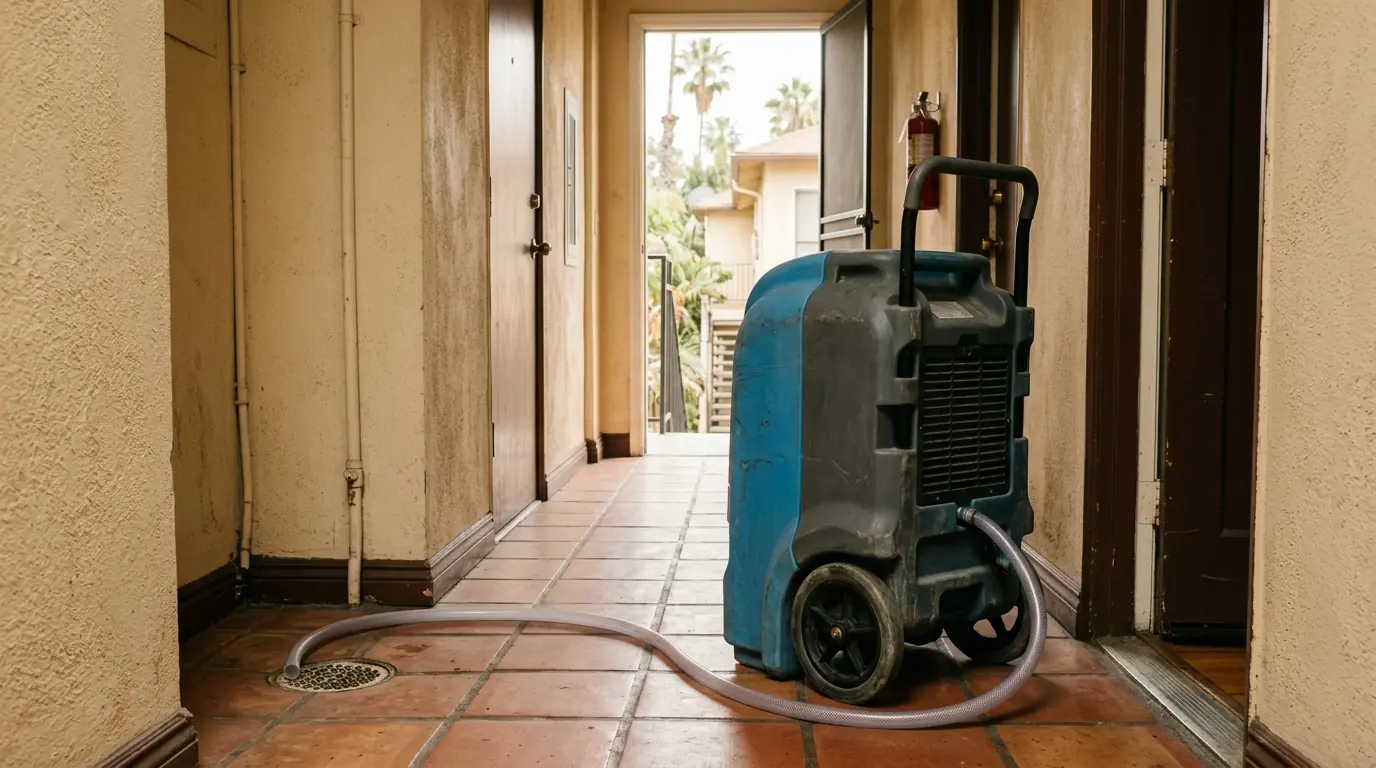
Drying is controlled evaporation. Air movers pull moisture out of materials into the air, and a dehumidifier pulls it out of the air so it does not settle back in. Where water got behind a wall, we push dry air into the cavity instead of cutting the whole wall open.
It is not a fan and an open window. Without dehumidification, the moisture just moves to the next cold surface. Plaster walls and dense floors take the longest.
Cost factors
What drying costs in Los Angeles
National 2026 guides put extraction and drying at $4 to $12 per square foot, and overall water damage work at $3 to $7.50 per square foot. Treat these as planning ranges; the scope sets the number.
Wet square footage
How far the water spread across rooms.
Material type
Plaster and hardwood take longer than drywall.
Cavity work
Injection drying behind walls adds equipment.
Water category
Contaminated water means removal, not drying.
Days on site
Equipment is billed by the day it runs.
Access
Crawl spaces and tight rooms take more setup.
Your options
Dry in place or tear out?
The water, the material and the time decide it, not the size of the stain.
| Situation | Dry in place | Tear out |
|---|---|---|
| Clean water, caught in a day | Usually | Rarely |
| Plaster walls | Usually, it takes longer | If it is crumbling |
| Soaked insulation in a wall | No | Yes, that section |
| Contaminated water | No | Porous materials come out |
| Hardwood that cupped | Often, with mats | If boards buckled |
Variations of this job
Wall cavity drying
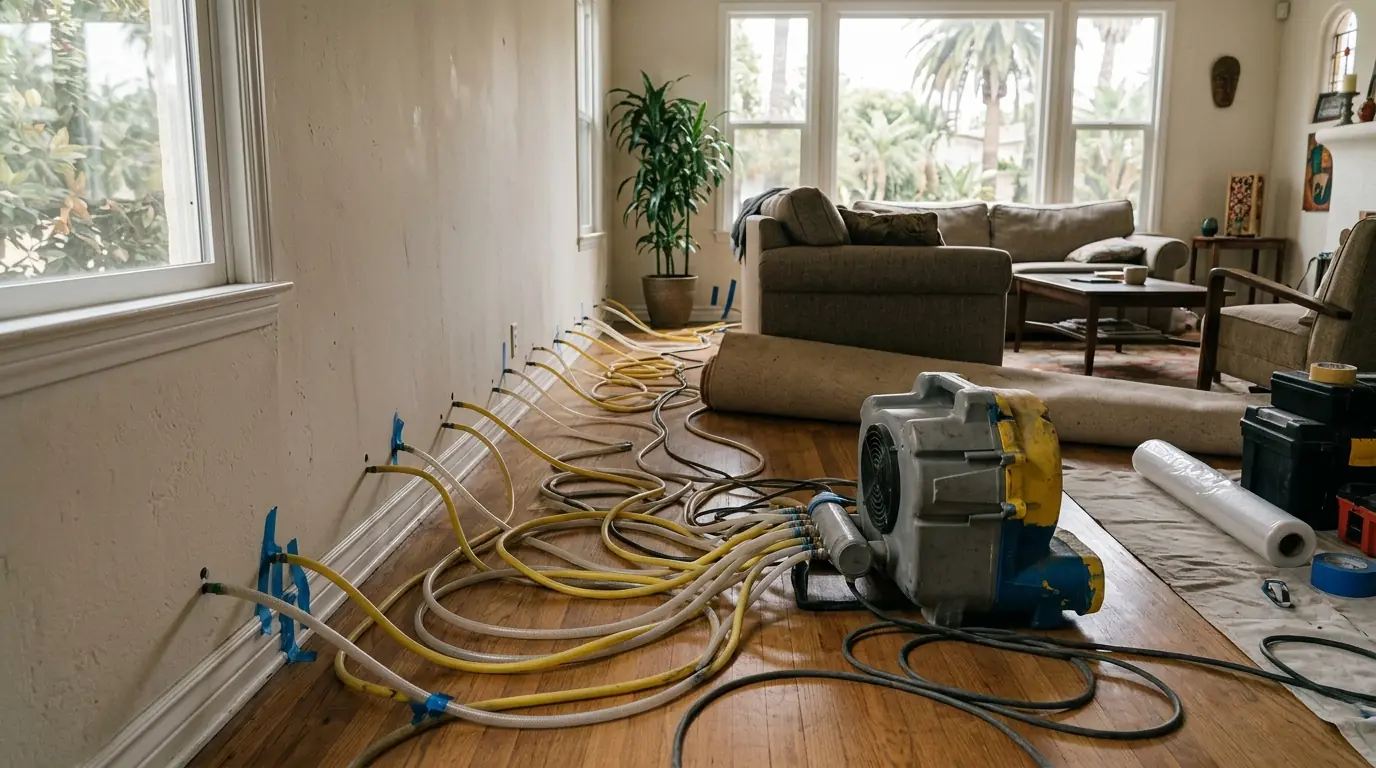
Wall cavity drying is used when water ran down inside a wall but the drywall itself is still sound. We pull the baseboard, drill small holes behind where it sat, and push dry air through the cavity with an injection system. The holes are hidden once the baseboard goes back. If the insulation inside is soaked or the water was contaminated, the wall is opened instead, because dry air cannot clean what the water left behind. Cavity readings are taken through the same holes each visit.
Subfloor drying
Subfloor drying deals with water that went under tile, vinyl, laminate or hardwood and into the plywood or concrete below. On wood subfloors we lift or float the finished floor where needed and run air under it. On concrete slabs we use drying mats and a dehumidifier sized to the room. Slab moisture is checked at several points, because a slab can read dry on top and still hold water in the middle. Flooring goes back only after the slab reads dry at every point.
Moisture monitoring
Moisture monitoring is what tells us the job is done. On the first visit we take readings on wet materials and on a matching dry area of the same house, then mark the points so every later reading is taken in the same spot. Readings are logged each visit with the date. The equipment comes out when the wet points match the dry reference, and that log goes into your claim file. Adjusters ask for exactly this record, with dates and locations.
What is included
What a drying setup includes
- Moisture map on day one
- Dry reference readings
- Air movers sized to the room
- Dehumidifier sized to the room
- Cavity drying where needed
- Daily or every-other-day checks
- Dated reading log
- Photos of each setup
- Final dry readings for your file
Water got into the walls? Call and we will map it before it turns into a mold job.
Call (323) 709-0141Los Angeles conditions
Plaster, lath and old houses dry differently
Much of the housing in Los Feliz, Silver Lake and Echo Park predates the 1970s; less than a fifth of it was built in the last 50 years. That means lath and plaster walls, original hardwood over plank subfloors and cavities with little or no insulation. Plaster holds water far longer than drywall, so these jobs run a few days longer and get more reading points.
Time
How long drying takes in a typical house
Three to five days is normal for drywall and wood framing when drying starts the same day. Plaster walls, hardwood floors and slabs often need five to seven.
How the job runs
How a drying job runs day by day
WetDry and signed off
- 1
Map the wet area
Meters and thermal imaging trace where water went.
- 2
Take a dry reference
Readings on the same materials in a dry room.
- 3
Remove what cannot dry
Pad, swollen trim and contaminated drywall.
- 4
Set air movers
Angled along walls to move moisture off surfaces.
- 5
Add dehumidification
Sized to the room so moisture leaves the air.
- 6
Log readings
Same marked points, dated, every visit.
- 7
Pull equipment at dry
When wet points match the dry reference.
FAQ
Drying questions
Please do not. Drying stalls when it stops, and the days add up. The noise is the job working.
Dehumidifiers put out heat, and warm air holds more moisture. That warmth speeds drying.
The wet points are read against a dry reference in the same house. When they match, it is dry.
Not if the water was clean and caught early. Cavity drying through small holes behind the baseboard often saves them.
Drying fast is the best prevention. Mold needs moisture held for a day or two; we take that away.
Drying after a sudden covered loss is usually part of the claim. Our reading log documents it.
Related work
What else the same leak can lead to
Hardwood Floor Water Damage
Cupped hardwood
What hardwood Floor Water Damage involvesCarpet and Pad Water Damage
Carpet extraction
What carpet and Pad Water Damage involvesDrywall Water Damage Repair
Flood cut
Drywall Water Damage RepairWater Damage Reconstruction
Flooring replacement
How we handle water Damage ReconstructionContents Pack-Out and Cleaning
Furniture and electronics
Contents Pack-Out and CleaningWet walls or floors that will not dry?
Call and we will map the moisture and set the right equipment.
24/7 emergency line
(323) 709-0141